
Ep. 532 Medicine Has Lost Its Way – The Most Honest Take on What’s Broken with Drs. Lazris & Roth

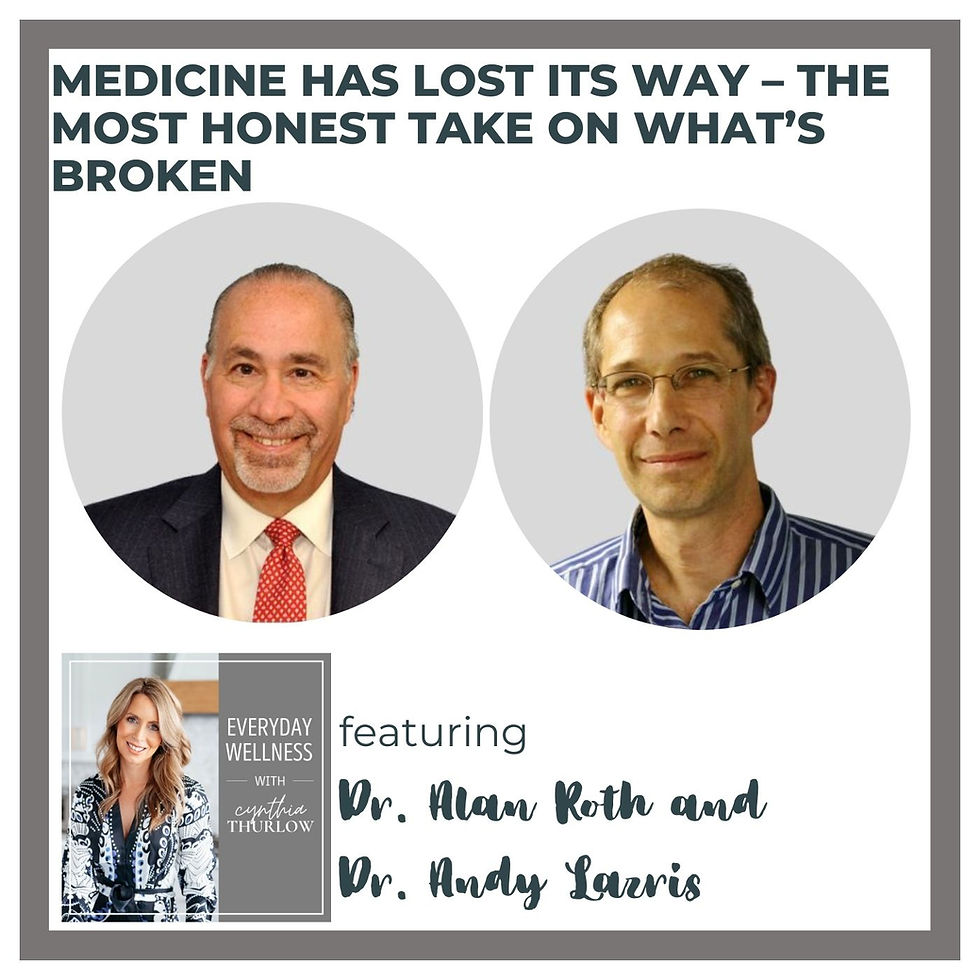
Today, I am honored to connect with doctors Andy Lazris and Alan Roth, the authors of A Return to Healing. Dr. Lazris, a physician practicing geriatric primary care medicine in Maryland, is a Certified Medical Director who orchestrates medical care and provides education for several long-term care facilities. Dr Roth is a physician, practicing family medicine and palliative care in New York. He is the Chairman of the Department of Family Medicine and Ambulatory Care at MediSys Health Network.
In our discussion, we explore the impact of the Flexner Report, including how it has reshaped our medical system and clinical guidelines, expanded the definition of disease, and influenced critical thinking. Drs. Lazris and Roth explain how challenging established medical dogma becomes even more problematic within a Flexnerian framework. They examine the prevalence of ineffective and costly procedures, the manipulation of research studies, the role of documentation in medical literature, and the impact of terms like non-compliant and histrionic on the quality of patient care. They also clarify what actually happens with screening measures and how patients can find excellent care.
Their book, A Return to Healing, is truly a love letter to their communities. It is a must-read for anyone seeking to understand the complexities of our current medical system and how it has gotten derailed.
IN THIS EPISODE, YOU WILL LEARN:
Why doctors should question dogma and think critically rather than just following medical guidelines
How medical training encourages standardized testing and discourages nuanced and patient-centered thinking
How our profit-driven system rewards procedures and prescriptions over proper patient care
Why drugs can sometimes cause more harm than good, and how elderly patients often suffer due to overprescribing
How drug companies manipulate statistics to make small benefits seem huge
Why patient noncompliance can often mean informed refusal rather than ignorance or defiance
How biased medical documentation may unfairly target women and minorities
Modern fast-food-type medicine and eroding trust within the doctor–patient relationship
Why shared decision-making is meaningless in a system built on one-size-fits-all dogma
Protecting yourself within a dysfunctional medical system
“Our nation pays clinicians to do things to people rather than for them.”
– Dr. Alan Roth
Connect with Cynthia Thurlow
Follow on X, Instagram & LinkedIn
Check out Cynthia’s website
Submit your questions to support@cynthiathurlow.com
Connect with Dr. Andy Lazris and Dr. Alan Roth
On their website
Email Dr. Lazris: alazris50@gmail.com
Email Dr. Roth: aroth@jhmc.org
Transcript:
Cynthia Thurlow: [00:00:02] Welcome to Everyday Wellness Podcast. I'm your host, Nurse Practitioner Cynthia Thurlow. This podcast is designed to educate, empower and inspire you to achieve your health and wellness goals. My goal and intent is to provide you with the best content and conversations from leaders in the health and wellness industry each week and impact over a million lives.
[00:00:27] Today I had the honor of connecting with Drs. Lazris and Roth. They are the authors of A Return to Healing. Dr Lazris is a physician practicing primary care and geriatric medicine in Maryland. He's also a Certified Medical Director, orchestrates medical care and provides education for several long-term care facilities.
[00:00:48] Dr. Roth is a physician practicing family medicine and palliative care in New York. He's the Chairman of the Medisys Health Network Department of Family Medicine and Ambulatory Care and today we spoke at length about the impact of the Flexner Report, how this has contributed to changes across the medical system as well as guidelines. It has also extended the definition of disease and has impacted critical thinking. How questioning established dogma is increasingly problematic in a flexnarian world view, ineffective costly procedures, issues around research studies or aka statistical trickery, the role of documentation in the medical literature, as well as utilizing terms like non-compliant or histrionic on the quality of care to patients, what really happens with screening measures and how to navigate finding excellent care.
[00:01:43] Drs. Lazris and Roth's book A Return to Healing is a must read, especially for those who are trying to understand the complexities of our current medical system and how it has gotten increasingly derailed. This is truly a love letter to their communities and a book that I've listened to and read more than once.
[00:02:05] Welcome to the podcast. I've been really looking forward to connecting with you both and for listeners your book A Return to Healing is a book I have read twice and really resonated with me as a clinician and as an individual who navigated end-of-life care for two family members last year when I was throwing my hands up in the air and saying, “What are we doing?”
Dr. Alan Roth: [00:02:26] So Andy is a geriatrician and in addition to me being a fat palliative care doc and hospice doc, I'm a family doc. So I see it from early on to end of life and it's unfortunate what we're seeing happening to our communities, our world, and what we're doing to patients rather than for patients and their families.
Cynthia Thurlow: [00:02:48] Well, and I think there's a lack of critical thinking that's ongoing. I think ultimately, I say we as a group of clinicians in many instances have kind of been pushed into practicing defensively as opposed to ultimately having shared decision making with our patients. At the very beginning of the book, you both discussed the Flexner Report and the net impact which has been pervasive, catastrophic, if you will. Can we start the conversation there just to give listeners some perspective about what the Flexner Report actually did and how that has influenced our current modern day system?
Dr. Alan Roth: [00:03:23] Sure.
Dr. Andrew Lazris: [00:03:23] Yeah, The Flexner Report, no one's heard of. And if you look at, even at Hopkins, where I was attending for a while and you were trained, you don't hear about Flexner, you hear about Osler and Welch. And Welch is probably more important than Flexner in the report and the library's named after him. He was a great eugenicist [laughs] on top of everything else. But up until about 1900, medicine was a disparate field. There were homeopaths, there were alleopaths or many different groups of people. And the orthodox medical world which had evolved in this country since about 1840, when the AMA came into being, was very much into the progressive idea of human beings are measurable and that was also where it overlaid with eugenics.
[00:04:12] Almost everyone who created the modern medical world were also eugenicists who believed that people could be subdivided into groups based on testing. The AMA, which had been trying to consolidate power, did so by jumping on this progressive train and aligned with corporate interests, specifically the Rockefeller and Carnegie foundations as well as the growing pharmaceutical industry, which before the AMA allied with them in about 1900 because it was against their code of ethics, which they changed, they were losing money and then they became a powerhouse. And they work with progressives to try to get laws passed in States to require licensing. And then came the report.
[00:04:51] The report was done by the AMA several times prior to the official report which was sanctioned by the Carnegie foundation, which basically ranked all the medical schools, got rid of about half of them, said they were not up to standards. Including almost all the African-American schools, schools for women, the ones for alternative medicine, were all axed and created what was basically a laboratory in a school. So instead of going with what William Osler said at Hopkins, which is “The patient needs to be immersed in patient-- “The student needs to be immersed in patient care from day one”, this was all about sitting in a classroom memorizing things and learning physiology. One of the more famous flexnarian said that “The body is as measurable as a bar of steel.”
[00:05:34] And most of these people who created the report felt that speaking with patients was a distraction because they had subjective ideas, symptoms were a distraction. What it was about is what was measurable. And the corporate interests were very interested in that because now we are creating medicines, we're using medical schools as laboratories to create new products. And it became this really ugly alliance with the AMA in charge. So all licensing became predicated on AMA sanction and going to a sanctioned medical school. These medical schools, because they had to build labs and get full time faculty, could not survive without corporate funding. So hence began this idea that the corporations were going to be running our system and that people were measurable. And our goal as doctors was to measure and fix numbers. So we became a number fixing system instead of a patient healing system after 1911.
Dr. Alan Roth: [00:06:28] I always hate following Andy because he says it all. But you know, we have several enemies. We're primary care docs. Andy is a general internist, I'm a general family doc and he practices geriatric end-of-life care. I practice hospice and palliative care. And our big enemy is unfortunately the medical industrial complex, which is Big Pharma, device makers, the insurance companies. Unfortunately now, venture capitalists taking over the healthcare system as well as our government, which has not recognized the fact that if everybody had a great doc, primary care provider whether it's a nurse practitioner, I'm also a PA by the way.
Cynthia Thurlow: [00:07:14] We're all covered on this podcast today. [laughs]
Dr. Alan Roth: [00:07:16] So, if everyone had a usual source of healthcare, someone they could go to with a question, and they don't end up at the first visit with the cardiologist who's going to do like the first $50,000 worth of tests and send them to the gastroenterologist, the rheumatologist, the orthopedist, and then they finally end up with the mental health practitioner they needed, which would have been one of us, we would all be fine and we would have saved 150,000 in that workup and the patient would have been a lot less stressed because it was with their usual source of healthcare who was making them feel better on a daily basis because they trusted this provider. We know about long-term continuity relationships and how important they are.
Dr. Alan Roth: [00:08:04] And unfortunately, the medical industrial complex, which includes, unfortunately, the medical societies that represent medical professionals and the medical societies that reach the patients, whether it's the American College of Cardiology, the American Medical association, or physician groups like The American Heart Association and Alzheimer's Association. So, all these groups are getting their money from farmer and lobby groups and lobbying Congress to keep the status quo and what is happening, our healthcare dollar is getting bigger and bigger. We're wasting more and more money to live shorter and less productive and happier lives. And, happiness and health go hand in hand and we don't have any of that now.
[00:08:56] And we would understand that the $4.5 trillion we're now paying if people were healthier, happier, less adverse outcomes, less malpractice, less all of the bad things that we see happening to medicine and all the good things happening to patients, it's for what we do for patients, not to them. But what we do to people makes the money unfortunately.
Cynthia Thurlow: [00:09:24] Yeah, it's really interesting. So, my training was in the 1990s, and I became a nurse practitioner in the early 2000s and really being able to look at medicine objectively over the last 25 years and talking to colleagues, physicians, nurses, nurse practitioners, PAs, everyone is feeling like they can't deliver the kind of care that they want to. So that's number one. There's a lot of provider dissatisfaction with the current system. And then also, when I talk to younger physicians feeling a tremendous sense of pressure that they have to end up in specialty areas because they have many massive student debt. Not everyone's parents were independently wealthy and put them through medical school. And I think in a lot of ways, we've gotten so siloed in medicine.
[00:10:08] I know for myself, if I deviated from the plan, if it was not a cardiology-related symptom, I would get admonished by my colleagues. They're like, “Cynthia, don't talk to the patient about X, Y or Z. Don't send the patient to the ER.” “Send them back to internal medicine or primary care to figure this out” and I said, “How does that make sense for this patient? Why are we making things so much more complicated than they need to be?” I can imagine, as family medicine and also a gerontologist that you are equally frustrated with the direction that healthcare has gone in where we're so siloed, we're so subspecialized.
[00:10:44] I think for a lot of patients, they make the mistake of the tripwires, they end up in the emergency room with, God forbid, chest pain or God forbid, they have rectal bleeding, because that then precipitates in more circumstances very likely a protracted hospitalization, seeing multiple providers. They get nosocomial infections. They might go home with more prescriptions than they started with. They're confused. They're trying to navigate the system and if they're fortunate enough to have an Internal Medicine Family Practice quarterback, they're lucky. But I feel like a lot of patients, what I hear from them is they feel like there's no one that's on their side anymore. They're struggling to make sense of a system that is, effectively in many ways, dysfunctional.
Dr. Andrew Lazris: [00:11:27] And, you know, the Flexner Report did not itself sound the death knell of primary care, but it was inevitable. Because once you start creating numerical barometers of health, and what do I mean by that? “What's your cholesterol? What's your blood pressure? What's your sugar? What's your bone density?” And we talk about all these in our book. They don't actually define health at all. And then, of course, because the drug companies are so involved in creating protocols, lobbying, and influence. So the American Heart association just came out with new blood pressure guidelines. The American Heart Association is basically an arm of the pharmaceutical companies. That's who pays them, and that's who's on their executive board. So their guidelines are so absurdly ridiculous that they would harm anyone who followed them, especially an older person.
[00:12:13] So once you start creating these numbers, then you could start expanding the definition of what's disease. So we've seen, for instance, diabetes, that the number you need to get diabetes, the sugar keeps going lower. And then they invented a disease which is not a disease at all. We wrote an article about it called Prediabetes. And now 75% of adults have diabetes or prediabetes, more medicines, more doctor visits, more tests. This is also true with atrial fibrillation, which is arrhythmia of the body. We know, especially in older people who are frail, that treating it with blood thinners increases the risk of death and stroke. Cardiologists go by these protocols that are fed to them by drug companies, calculators fed to them by drug companies. I've been hung up on by cardiologists who I question their studies they're using.
[00:13:02] One guy was an EP specialist, all he does is rhythms. And I said, “What studies were in this calculator?” He had no idea. So I sent him a couple studies and he hung up on me because he didn't want to hear that. The protocolization of this is geared by the drug companies. And one of our problems that Alan and I have is something you brought up, which is the lack of critical thinking among doctors. Doctors may be frustrated because they are being judged by how well they control people's numbers, but I haven't seen too many that are willing to go against that narrative and actually think critically.
[00:13:40] They think if the cholesterol is lower, someone's healthier. If the sugar is really low, they're really healthy. Okay, the sugar is really low, they're tired, they're dizzy, their thinking is worse. But these doctors don't care. Well, go see another specialist for that, but I've taken care of my job. We got your sugar low. And there's little connection between this number fixing and the health. And as we've been fixing numbers, lifespan has been going down, chronic disease has gone up. We have the highest burden of chronic disease.
[00:14:09] Alan and I recently talked about a study in the Journal of the American Medical Association, not our favorite journal, also heavily paid for by drug companies, but that talked about how our fall risk and deaths from falls in this country has increased dramatically while in the rest of the world it's gone down. You don't have to be Einstein to know this is from our over treatment of everything. And of course they're dying more because everyone's on a blood thinner now.
[00:14:36] So it is unfortunate that once we developed a number-based system, it created a specialty-based system. Alan and I have kids, three among us in medical school or medical training. And when we bring up the idea of primary care, they just laugh and laugh. No one goes into it. My son said it's too hard and you don't get paid enough for what you do. Specialty is much easier. One, you're dealing with one organ. If you don't, something goes wrong, you send them to another specialist. [Cynthia laughs] So it's really become we're an extinct species. So you're talking to two extinct people, right?
Dr. Alan Roth: [00:15:08] So, me and Andy agree on most of what we say and we're agreeing now. I wanted my son to join my practice and he's like, “I'm not working seven days a week like you work. I hear the phone going off at 01:00 AM, 03:00 AM, and 04:00 AM” because we care about the people we take care of, not the numbers and this, that and the other thing. But, Andy's 100% right. I could tell you that 95% of doctors, nurse practitioners, and PAs do not read the scientific evidence about the calculators. They're using the evidence-based guidelines, whether it's asthma, hyperlipidemia, diabetes. They're just taking it for granted that this stuff is real.
[00:15:52] And we know it's not real because we know it is funded by the medical industrial complex, which is purely for more medicine, more procedures, more tests, more money. And the system is simply not sustainable. If you ask us, maybe we'll get to this in the end. It's like a simple answer. How do you fix the healthcare system? If you look, like, right now we're up to almost $16,000 a year, we're paying per human being per year for healthcare. If we took like 600 of that, so you have 16,000 for the rest of the medical industrial complex.
[00:16:32] Give me and Andy $600 per member per year and we will save you the other 16,000 by healthy eating, exercise, mindfulness, mental health counseling, cutting down on the medications they're taking rather than more that we will do things for people rather than to people and cut down the cost and make this a better country to live with more longevity, less cost, and less fricking grief that we're giving to everyone in this world. It's just utterly absurd. Like we have forgotten about the word common sense in this country because AI has taken over for common sense. And it's just really unfortunate because we could do so much better for our folks.
[00:17:22] If you have a heart attack, if you have a stroke, if you get shot, we are the best country in the world to be in because we will save you because we have the best toys and technology anywhere. But when you're done, go to McDonald's and go to Popeyes and eat all that crap, don't exercise and take the 15 drugs we're giving you, make the medical industrial complex happy and we'll see you at your next neuro or cardiac intervention.
Cynthia Thurlow: [00:17:53] Yeah, I think for listeners, it's hard to get a 360-degree view of what's transpiring. I know that when I was still working in Cardiology, I did that for 16 years, inpatient/outpatient management. I was part of that machine. And I grew increasingly disillusioned. And I recall at one point, because I went back and did nutrition training and I was like, “I really think we're missing the boat on this risk factor modification. We're telling patients to eat low fat, but really, I don't think that's what we need to be telling them.” This lifestyle piece we have to be talking about and I recall that several of my peers who were about my age, they're like, “Oh, this is cute. We have this nurse practitioner, she likes to talk about food and lifestyle.”
[00:18:35] And they would refer people to me, but the patients generally were like, “Just give me the pill. I'm not going to change what I'm doing. I'm not going to stop smoking. I don't want to exercise. Don't ask me to manage my stress.” And I think in many ways, we've gotten so far away from lifestyle as medicine as a focus to-- We've now convinced our patients that every symptom requires a prescription and every single symptom then requires seeing a subspecialist because I had patients that would say to me, “I'm not willing to work up my cough here. I want to go see the pulmonologist. Or I think my reflux is worse, I want to go see gastroenterology.”
[00:19:11] And I think for so many listeners, they may not fully appreciate if they're not in healthcare right now or have a healthcare background of how fascinating. I'm using that word loosely, fascinating this progression of how we look at patients in the system and how we integrate what they're doing, and I love that you brought up some of these ineffective costly procedures. How common it is that we're diagnosing people with osteopenia when in fact, they don't actually have a bone health issue, it's just a normal variant for them. But everything is diagnosable and therefore treatable with either monitoring metrics or monitoring with medication and referring out to specialists.
[00:19:55] And I'm curious from your perspectives because you're your boots on the ground clinicians. When you're talking to patients about, let's use the example that you brought up atrial fibrillation, which we know is more common with age. We used to call it the holiday heart. I saw a lot of patients in the holidays that would have a little more alcohol, more common to see in women in menopause. How are you navigating conversations about stroke when they are scared out of their mind when they go to the cardiologist and they're quoted quotes of like, “You have an 8% chance of stroke risk this year”, having to navigate conversations around relative versus absolute risk?
Dr. Alan Roth: [00:20:33] So, I will let Andy go first because this is his favorite topic, but I'll follow it up with a little more practical. But this is Andy's biggest pet peeve in life I believe. [Cynthia laughs]
Dr. Andrew Lazris: [00:20:43] I have many pet peeves, but fibrillation is one of them without a doubt. And one of the reasons is because-- And if you ask AI about AFib, it'll feed you drug company studies, but most drug company studies, which are most studies in fibrillation, have shown that, the stroke risk goes up if you don't take a blood thinner-- You have a stroke risk whether you take a blood thinner or not, but the stroke risk will go up. But what is a stroke? And that's the biggest issue. In these studies, the doctors don't realize most strokes are asymptomatic. They're just little dots on a CAT scan. That's what they count as a stroke.
[00:21:20] If you look at symptomatic strokes, you're narrowed down to two or three studies, they look at that. These are the ones I sent back [crosstalk] but we considered that irrelevant information. What I call strokes, you notice. Now the benefit of these blood thinners is really small. On average, about 0.5%. Five or six out of a thousand people will prevent a noticeable stroke, 70% of which will improve completely. So it's not a big deal. But what we also know based on studies is that especially if you have any frailty and that means your balance is bad, that your risk of a stroke from the blood thinner or death is closer to 2% per year and about 15% of people per year end up in the hospital with major bleeds. So I give my patients that information.
[00:22:03] They'll then tell me, “Well, the cardiologist said I might get a stroke before I get home if I don't take it.” [Cynthia laughs] And they quote like you say these huge numbers, but I'd say the vast majority of my patients are now off blood thinners. I couldn't get my dad off blood thinners by the way. He said he'd rather die from the medicine than not from the medicine, and I think he did. But in the end, most of my patients are off them. And I also quote the fact that I've taken care of hundreds of hundreds of patients with fibrillation, not on blood thinners. And I don't remember a stroke. If these [chuckles] statistics are right, where are all these strokes we're supposed to be seeing? I haven't seen them, but I have seen bleeds galore. We have an epidemic of bleeding right now.
[00:22:46] And by the way, that's good for the whole medical Industrial complex. You make people bleed, they go to the hospital, they see 20 other specialists. More money, more money. So, patients have to realize, unlike in countries that have a more centralized, government run healthcare system, our system benefits from you being sick. The sicker we can get you, the more money we make. And, that's an unfortunate side effect of the flexnarian system that we have, which by the way has constantly pushed back against any central insurance. But as we see with Medicare, Medicare now is completely influenced by Congress 100%. Congress has lobbied heavily. What's the number one lobbyist in Congress? The American College of Cardiology.
Cynthia Thurlow: [00:23:27] Yep.
Dr. Andrew Lazris: [00:23:27] We don't have a lobby group in primary care [chuckles]. So, they're being lobbied to death to pay for things that are useless. You bring up bone density. Bone density is measurable. Bone health is not measurable. You do yoga all the time. You might have a low bone density. Why? Because your bone is very flexible. That's a good thing. Low density could be good. So we got to look at you, what you do, what your overall health is, not just this bone density number, but you go to an endocrinologist or another specialist, they're going to treat you with these medicines that could make you much worse and your number will improve. And you think that's good. So, the problem with most of my patients is they have been fed this line everywhere. Like my mom says, “Well, everyone's saying the same thing.”
[00:24:12] Yeah, well, CNN, Fox, Congress, American College of Cardiology, CDC, almost all of them are completely financed by drug companies. Doctors are non-thinking drones very often, they are taught that way to have one right answer, they're fed by protocols from the drug company. Everyone's saying the same thing, but it just happens to be wrong. [laughs] Unfortunately not patient-centric. It's all about each individual person.
Dr. Alan Roth: [00:24:38] The other thing we know is, after the medical industrial complex lobby, the next biggest lobby is the food industry. Take your drugs, go to McDonald's, take more drugs, go to Popeyes, take more drugs. We have medicalized aging. Getting old is now a disease. Whether it's your bone density or your cholesterol, whatever it is, prediabetes, osteopenia instead of osteoporosis, everything is a disease that is scaring the crap out of people that think they're dying because they have prediabetes, they have osteopenia, they have atrial fibrillation, all things that won't change their life and we're going to throw more apps at them, more protocols at them, more drugs at them, more protocols at them.
[00:25:29] And like Andy said, you're more likely to die on your way home from a car accident or you’re more likely to die your way home from a car accident than the AFib that they tell you you're going to die from in 15 minutes. People are not scared to drive home. They're driving home, but they're scared. We could go on and on. It gets more complex. Andy's next best peeve is the watchman procedure for AFib. If he can't take an anticoagulant, throw a device in your heart. It gets crazier.
Dr. Andrew Lazris: [00:26:01] And you asked me how I navigate it. Just before this, I gave a talk on wellness to a bunch of hundred elderly people and I talked about the pillars of wellness. I too went back to get nutrition training. My daughter was in medical school, one of the few medical schools that teaches nutrition.
Cynthia Thurlow: [00:26:17] Amazing.
Dr. Andrew Lazris: [00:26:18] After her nutrition course, she said, "Dad, our two-week nutrition course is done and we didn't mention any items of food." Just so you know where doctors are coming from here. I went back and got training in that and I talk about it and I can convince my older people that eating well and exercising are really the keys. What helps in these talks is people chime in and they say, "Yes, since I stopped my statins and my blood thinners and two of my blood pressure medicines, I feel so much better now I can walk and I just feel like my whole life has changed." And they're all hearing that.
[00:26:49] To some extent, group activities have helped me a lot because the people who are listening to this and who do embrace the idea that we are in charge of our own health and that we can make a difference and that we are the ones who are going to determine our future, not the doctors. Studies have shown that over and over, they teach other people and I think that's been a good thing.
Cynthia Thurlow: [00:27:12] That's truly invaluable. I think about conversations I had with my father, who was on statins for years and last year had a series of falls. I'm sure you both can imagine what happened. He ultimately fell twice and had massive subdural hematomas. For listeners, those are head bleeds. At 80, he elected not to have surgical intervention, which I agreed with a 100% because he was very frail.
[00:27:34] I remember having conversations with him because we then got him in hospice and he passed away two weeks later. Having conversations, "Do you think it's the statin that made me fall?" Because I kept saying, "Dad, I think you're on a maximized dose of statin therapy, you're sarcopenic, you're weak, you're falling, you're frail. Yes, I do think that contributed to what was happening." He said, "I wish I had listened to you 10 years ago" and I said, "Dad, it's irrelevant right now." For how many patients, maybe it's tough in their circumstances. Maybe right then they feel good and they're like, "I don't know if your family's like this, but sometimes I get no respect within my family." I'll tell them something and like “Oh, I'm going to wait till I talk to my internal medicine, my doctor." I'm like, "That's fine." Then they'll come home and say, "Well, they agreed with you."
[00:28:15] But the point of why I'm sharing this is there's a lot of polypharmacy, there's a lot of misinformation, there's a lot of rigid dogmatism. I know you talk about cognitive dissonance. Patients can also be a little bit cognitively dissonant, but I think the medical establishment, sometimes it's hard to entertain the possibility that what we're taught in training is not accurate or if we're pushing back against conventional wisdom. Sometimes it's hard to be the person screaming into the wind and you're feeling like, "I'm getting drowned out." That's why I love the work that you both are doing, that you're so instrumental in making sure that you're bringing this information to the forefront. Let's talk about critical thinking and this rigid dogmatism that is still-- it probably always will be problematic. But I think for a lot of licensed medical professionals, it's very hard for them to believe that maybe what they were taught or trained in is actually not correct in terms of research and application to disease processes.
Dr. Andrew Lazris: [00:29:14] William Osler and Albert Einstein would agree that you must question everything and that the true doctor is one who rejects dogmatic thinking and constantly learns. It was Osler who said that the experienced doctor-- the young doctor treats one problem with 20 medicines. The experienced doctor treats 20 problems with one medicine and he believed that experience means everything. You're going to read things and put them in the context of your experience. That just flies in the face of dogmatism. If you're just going to listen to what the CDC says today, which might be different than yesterday, I've called the CDC on things, and what they tell me-- I ask for studies multiple times and they say, "No, this is expert opinion." [Cynthia laughs]
[00:30:00] I happen to know and we talk about it in the book that the experts in the CDC are basically ex-pharmaceutical executives, so their opinion is [laughs] irrelevant, but the dogmatic thinking is really-- and you have to understand, and you know this, that doctors are trained. They're admitted to medical school by their ability to take a single standardized test, the MCAT, which requires you to have no nuance in your thinking. One right answer throughout medical school. Test, test, test just like that. And then when you're a doctor, you're tested the same way. Nuance is very discouraged, patient-centric thinking. When I look at these questions, I say, "Well, it depends who the patient is," but you can't do that. That's why I do badly on these tests, because I think too much.
[00:30:46] Critical thinking gets in the way of your ability to succeed now as a doctor. Following protocols is safe on many levels. It's safe because you're going to make more money and safe because you will get sued less or successfully sued less. It's safe because the patients do have cognitive issues that are derived from our terrible system. Our system understands cognitive dissonance and the fact you could trick a patient into doing something against their interest like stenting is a good example. Obviously, people have a 90% blockage. "While fixing it makes sense. Joe had a stent, he's alive." These smart doctors are saying it. Everyone I talk to says it. I could show them data. That data goes against their cognitive thinking and they believe their cognitive thinking and that's just part of who we are as human beings.
[00:31:36] So it's not their fault, but doctors play into this cognitive dissonance. They just buy into all this number fixing instead of healthy lifestyle because it's much easier and it makes sense to them. The dogma has been created by those who are going to make the most money and even the drug companies say their best army of promoters are doctors because doctors blindly follow protocols and dogma because that's what they were taught to do and they will just do what is best for the drug companies. That's sad. Doctors aren't dumb people, but they were trained this way.
Dr. Alan Roth: [00:32:13] And unfortunately, patients are innately trained to believe the specialist has to know more. [Cynthia laughs] It doesn't matter that they're getting $50,000 for this cardiac cath or to pull this clot out of you. That is irrelevant. It doesn't matter that we spend an hour with a patient and get 100 bucks. That doesn't matter because we care about the patients. What matters is the outcomes and unfortunately, our nation pays clinicians, whatever kind of clinician you are, to do things to people rather than for them and what helps them and unfortunately, patients are trained that they want stuff done to them. The more you do for them, the better it's got to end up being. They don't understand it's not the case.
[00:33:03] Give them the next drug and the next procedure and the next test and the next this. When I fell and broke my hip, Andy and Alan said, "Don't take that extra drug because your blood pressure is already 90/60. If you add Entresto to that list, it's going to be 50/40 and you're going to fall and break your hip." You fall and break your hip and it had nothing to do with the advice from me, Andy, or the cardiologist. It was just, you know, I fell and broke my hip because I'm 87 years old. Why did we do this to this 87-year-old where the evidence shows that they might have lived three more weeks by being on this additional cardiac drug or renal drug or diabetes drug or whatever drug it means.
[00:33:51] For the 40 years that me and Andy have been practicing, people did fine on 5-cent glipizides to lower their sugar and live just as long or longer. People in parts of the world that have a plant-based diet and work the land live longer and better. Why are these people living longer and better than we are in this country? Because our healthcare system just sucks, it is dysfunctional, and it is about profits over patients. It's simple.
Cynthia Thurlow: [00:34:19] Yeah, it's incredibly disheartening. Again seeing it from the inside out, last year my stepmother had AFib. She had been ablated. They had done everything you can imagine. She was on antiarrhythmics. She was on aspirin, Plavix, and an anticoagulant and had multiple series of falls and I finally said to her internist at the facility where she was, I said, "At what point are you going to hear when I say to you she does not need to be on antiplatelets and anticoagulants." In fact, I'm going to argue that eventually at some point she's going to fall and she's going to hit her head or she's going to have some catastrophic bleed. At the age that she's at, she was almost 90 years old, I said, "Why would we continue this?" And I remember that was this pushback about quoting statistics. And I said, "but she's end-stage Alzheimer's and she's starting to fall." At what point are we going to be thinking about what ultimately is best for the patient as opposed to looking at a statistic?
Dr. Alan Roth: [00:35:18] The specialists tell us we're crazy. They have no problem saying that me and Andy are crazy. "What do you mean you're not going to anticoagulate them? You're nuts." They believe we're crazy. If the doctors are believing it, what are the patients supposed to believe?
Dr. Andrew Lazris: [00:35:33] I've had cardiologists. One of my patients came in and said, "My doctor doesn't believe at my age I should be checking cholesterol." The cardiologist says, "I know who that nut job is." I considered it a compliment. [Cynthia laughs] We understand that. For instance, something we talk about in one of our articles is the fact that almost no statin studies were done in people over the age of 75, but 50% or more of statin prescriptions are written for people over 80. The drug companies know who to study and they know the doctors will just blindly prescribe it to everyone. The few studies we found over that age showed no benefit and significant increased pain, falls, even mental fog. But, again this is not what goes in their calculator.
[00:36:20] The calculator are the young people with high-risk heart disease that are now applied to everyone. Again, that's your dogmatic thinking, but then the calculator is pretty convincing to a patient and I become the nut job. Believe it or not, the patient who heard that told the cardiologist, "Well, I feel much better, so I'm sticking with the nut job." [laughs] That was his response. [laughs]
Cynthia Thurlow: [00:36:46] Well, I love that. Let's talk a little bit about statistical trickery and issues around research studies because I think this is probably one of my bigger pet peeves is that sometimes you'll see people spouting research and I'm like, either it's observational data, it's not a statistically significant amount of participants. There's a lot of different things that can be utilized to convince us that information is supposed to persuade us in one direction or another when ultimately it's just not high-quality research.
Dr. Andrew Lazris: [00:37:18] We know the drug companies are again good at this. There are a lot of people who talk about this. We quote a few. There's a guy named Dr. Ioannidis who is over at Stanford. There's Vinay Prasad who's at University of San Francisco, who's written a book called Ending Medical Reversals. We talk a lot about that in our book. We use examples of a couple of things. Observational studies are what we call correlation studies. If you do data mining, you look at all the people. I always say my favorite observational study would be you look at all the people that have heart attacks and a subset who don't and see what car they drive. [Cynthia laughs] You might find that people with the heart attacks, they have more Subarus and Priuses that they drive.
[00:38:01] Therefore we could say Subarus and Priuses reduce your risk of heart attack. We know it's a correlation. People who drive Subarus and Priuses tend to be eating better and other things. You could design an observational study to say whatever you want and then there's the idea of relative and absolute risk, which basically means if you can drop the-- and this was in the SPRINT blood pressure study, which is the only one used for our new blood pressure guidelines. You could drop the risk of heart attack from two out of a thousand to one out of a thousand. That's a one out of a thousand drop. They don't say that. They say it's a 50% drop.
[00:38:40] So now you'll hear, “Well, dropping blood pressure low is going to reduce your risk of death by 50%." Doctors don't understand this. Doctors are not taught any statistics or anything like this in medical school and they don't think about it, but the idea that you could expand a number like that so easily. In our book, I talk about someone who comes to the gym and it's really cold outside and he says, "Wow, the temperature dropped by 50%." It went from 3 degrees to 2 degrees. People just laugh because they know what a joke that is, but in medicine, for some reason, they buy these. If you see a percentage drop, don't believe it. That is a statistical trick.
[00:39:23] What we do when we look at studies is go to the data tables. I skip all the discussion. I look at two things. Who sponsored this study? Eli Lilly. Okay, I know a lot already. Then I go to the data tables and I see who they invited in this study. Is it similar to my patients? What are the actual benefits, what we call the absolute benefits, and what are the risks? Did they measure enough risks? In the blood pressure studies, they don't look at soft endpoints like tired, fatigue, brain fog and dizziness. They don't look at that stuff. That's what we see [chuckles] every day that affect people's lives.
Dr. Alan Roth: [00:39:59] I use a great example. I use it all the time now. This only happened to me about six years ago. I've seen about four patients with tongue cancer in my career, two of them came at the same time. They both had resections and then they went to the oncologists and they both got the same advice from the oncologist. "We think it's all out, but if you get radiated, we're going to reduce your chances of getting recurrent disease by 100%." Because two out of a thousand get it if you don't get radiation. Only one out of a thousand gets it if you do get the radiation. One of my patients chose one and one of my patients chose the other. I tried to fight them out of it, but they didn't.
[00:40:43] They might have been right, but the one that got the radiation was an obese type 2 diabetic. He can't even maintain his calories right now. He has no taste for food. They totally radiated his tongue, his esophagus. He literally lost 250 pounds. He is cachectic, he is depressed. He has literally lost his entire life to cut in half the reduction of recurrent disease in tongue cancer. The other guy, I literally told him the story, obviously without details or names, and he literally sheds a tear because he's living this vibrant life. He chose not to do it. It's five years out. He's seen multiple doctors, he's had PET scans, he's got no cancer in him and his life is great. The other guy's life is ruined for a 100% reduction. In what? In living? They reduced his life. There's no living.
[00:41:40] You could take any piece of data and in a patient-centered discussion, I could tell someone to cut your leg off and you're going to live longer. As Andy said, don't drive this car or the other car because it's affecting your life. We all know how BS all of this is. Doctors unfortunately have drank the Kool-Aid and they believe it. It's in their mind that reduction is real. They're not trying to hurt a patient. I don't believe any doctor truly wants to hurt the patient. They're doing what they think is right. If they treat a thousand tongue cancers in their life, they will reduce a couple of patients and maybe they will, but in the five I've seen in my career, I've only seen people's lives ruined.
Cynthia Thurlow: [00:42:30] I think how many patients get labeled noncompliant because they're unwilling to follow the recommendations by a specialist. I know that I'm embarrassed to admit this, but I'm going to say this out loud. There was a lot of patients being labeled non-compliant in medical charting. I think about the conversation that you just shared about your two patients and how they had wildly different experiences, one choosing radiation, one not choosing radiation, and the quality of life there and I think that in many instances, we need to be more conscientious about patient-centered, patient-focused care so that we have shared decision-making. We're sharing the best possible information with them and allowing them to make a decision that feels like it resonates because if we're making decisions as patients from a place of fear, we're never going to necessarily pick the right decision for us long term. Because I think for a lot of-- this has been my experience, a lot of my patients that are dealing with cancer diagnoses, it's so scary, understandably, that sometimes they're willing to do everything and anything. If someone says it'll decrease the likelihood they'll have a recurrence, they're willing to do it all because they're so fearful of going through this entire process again or something worse.
Dr. Alan Roth: [00:43:49] Me and Andy actually wrote an article on this too, about how documentation in the medical literature, whether you're a woman or from a minority group, that we're more likely to put someone is non-compliant and affect their future medical care, or that a woman is histrionic or an African American or a Latino patient is non-compliant. Then it gets perpetuated in the healthcare system that, "Oh, they're like that because they're non-compliant. So F them, we're not going to give them the appropriate care."
[00:44:22] Those people are actually more likely to get better healthcare because honestly, the richer you are, the more the doctors make on testing and procedures and more likely to do stuff for you that you absolutely don't need, which lead to incidentalomas, which lead to over-testing, over-treatment, over-diagnosis and screwing up your life. In some ways it's worse being an affluent white man in this country because you're going to get more bad things done to you.
Dr. Andrew Lazris: [00:44:49] I used to joke that I wrote a cartoon once, it said and it was about cigarettes. The rich guy said, "Oh, thank God I could afford this." The poor guy said, "Yes, it's really bigoted against us poor people. I can't smoke as much." That's our healthcare system in a nutshell. Isn't it funny that we talk about shared decision-making? I mean, God, we hear it all the time. But, in a numerical system where people are dogmatic absolutists, where there's one right answer and if you pick the wrong answer, then-- you worked in a Cardiology practice.
[00:45:22] I once saw a patient who had fibrillation and she wasn't on a blood thinner. I said, "Oh, I see, you're not on a blood thinner." And she just chewed my head off and [Cynthia chuckles] she said, "You're not one of those, are you?" I said, "I was in two Cardiology practices and they kicked me out because I wouldn't do this." She said, "No, no, I just was asking the question. Whatever you want to do is best as long as you understand the risks and benefits we'll talk about." Again, those risks and benefits have to be using absolute numbers and age-appropriate and circumstance-appropriate studies only. You can't just use everything. That requires some work on our part, but that’s what you are supposed to. You're supposed to trust us to have done that work, not read a drug company ad and do it that way. And that's part of the misplaced trust that a lot of people put in doctors, which creates a problem with shared decision making.
Cynthia Thurlow: [00:46:10] Absolutely.
Dr. Alan Roth: [00:46:11] Unfortunately, so many of-- I work in medical education. I spend half my life in patient care and half in education. Every time I've ever asked a resident who's working side-by-side with me and said, "Did you read the article behind the app you're using?" They look at me like, "What do you mean?" I was like, "Did you read the evidence for the app that you're using right now which is giving you this cardiovascular risk?" They don't even know what I mean, [Cynthia laughs] let alone read the article.
Cynthia Thurlow: [00:46:39] Hopefully that then lends itself that they then go look for said article. What are your thoughts? I probably already know the answer, but I got questions from my community. There are all these screening mechanisms now. You can pay for a head-to-toe MRI to screen for any abnormalities at an early stage. You see a lot of celebrities that are purporting that these are beneficial. I don't want to say any particular names of companies, but I would imagine given the conversation that we've had thus far, that you're probably not a fan [Andrew chuckles] of these screening modalities, but yet they're becoming increasingly discussed, talked about, purported. One of these companies reached out to me and offered to give me a ridiculous amount of money to talk about their product, and I just said, "I think that's not in alignment with my values or my community." I'm curious what your thoughts are. I'm sure you probably have seen these as well.
Dr. Andrew Lazris: [00:47:32] I'm looking at an article right now trying to see where it was-- I think the New Yorker and by Malcolm Gladwell called The Picture Problem, which talks about how screening, and we talk about in the book and articles. Screening actually can lead you down a really dangerous road unless it's done appropriately. To screen you reduce the accuracy of a test. There's another article in the New Yorker called The Total Body MRI which talks about what Alan mentioned, which is you're going to find a lot of things. I always tell my old patients, if we MRI’d all of you, there would be so much stuff in there to make the whole medical system happy. We could send you to so many ologists, but your body is taking care of them.
[00:48:09] Most of our cancers, our body is taking care. How do you get the body to do a better job of that? Well, fix the immune system, help your gut bacteria, exercise, stay away from smoking and things like that. We're going to find stuff that really doesn't need to be fixed. The example I always use is the 90% heart blockage, which is not going to increase your risk of a heart attack. It's all the little piddly plaque in your artery. We fix this little quarter-centimeter and we don't address what's actually the problem, you'll get a heart attack. My daughter called me and said, "You know dad, we just went over this stuff on stents and you were right." I said, "Yes." I said, "I'm shocked that they taught you that."
[00:48:50] Yes, every single study shows it. But again, we do a stress test, we find a problem and then the patient says, "Wow, thank God I had that screening test because I was feeling bad. I had this widowmaker in me and I would have died." It's just not true. The more we look, the more we're going to find, the more we find, the more we're going to expose people to toxic treatments. All good for the medical system, all bad for the patient. Cognitive dissonance, again. It sounds good. Sounds like it's great to find a problem early, but in most cases that's not going to happen.
Dr. Alan Roth: [00:49:23] We know the treatment for coronary artery disease that's stable as primary prevention of nutrition and exercise as close to a plant-based diet where people tell you "you're crazy, you're going to go on" something like that, but you truly want to live longer, you do that. We look at cancer screening, randomly training people. I participated in a study called Thermo Fisher - IN, real path finder study where it was a blood test that we did in our office for the 25 most common types of cancer. I can tell you in my data, in my patients, for every three positive tests, two were false-positives testing and patients underwent both scanning, some needed biopsies, and all the worry that they had to find out that there was nothing wrong with them to pick up something that the routine screening test probably would have picked up anyway. The system is just a mess. The more you test, the more you're going to find, the more you're going to treat, and the less people you're helping.
[00:50:26] Our national data just says it. We're doing more to everyone, but we're just spending more on living shorter. That's just the fact of life in this country. Higher mortality rates in mothers, higher mortality rates in children. Every data point in this country sucks and it's getting worse, but we keep just doing more and more and more and spending more and more and getting sicker and sicker and sicker because we are a sick care system, not a healthcare system.
Cynthia Thurlow: [00:50:56] We absolutely are. If listeners are unable to see you both as patients, how can the women that listen to this podcast, how can they search and find really good family practice internal medicine, depending on their age, gerontologists in their area? Because I think one of the biggest pain points that I deal with and my team and I talk to women all across the United States and abroad is finding a quarterback to help them navigate health and wellness. I think it is one of the biggest problems.
[00:51:30] If it's not just someone that now only does concierge or they can't get in to see their practitioner or they only get five minutes of time with them, it's a system that I feel in many ways patients are struggling because I do think there are especially a lot of my community people are looking for-- they want to have a collegial, helpful, mutually beneficial, symbiotic relationship with their internal medicine family practice provider.
Dr. Andrew Lazris: [00:52:01] It's one of the hardest questions you just asked and one that we're constantly confronted with. I always say, "You are in charge of the visit." A lot of people think that they are beholden to the doctor. You're in charge and you could ask them some tough questions. If people are not willing to answer those tough questions, they're not your right doctor. We talked about patient-centric care. If you don't want to do a certain thing or you question something, that doesn't make you a bad patient. If you feel like it does, then that's the wrong doctor also. A lot of it is trial and error, talking to people in your community, people who are like-minded with you.
[00:52:40] You're not going to find too many doctors who are up on nutrition, but I found more and more are, They're doing it on their own and they talk about longevity and wellness and you could go in and just your job to put yourself first and not worry about offending the poor precious doctor. [laughs]
Dr. Alan Roth: [00:52:58] I agree with Andy, but unfortunately me and Andy are kind of like dinosaurs. I agree. We're older folks and it's hard for me to turn my young learners into what I expect and I don't think it will ever be the same because of fast-food medicine. You got a sore throat, go to urgent care. If you have chest pain, go to the emergency room or go to the cardiologist and unfortunately, times are changing. To me, it's about finding a primary care. I think it's based on several things, and it's all based on relationships, communication, and trust. You got to find a provider, whether it's a physician, an NP, a PA, who you could have a relationship with, who's going to listen to you, communicate, have a continuity relationship and that relationship is based on mutual respect, communication, and trust. And if you find one of those, stick with them because it's getting harder and harder to find.
Cynthia Thurlow: [00:53:59] It really is. I feel like even in the part of the country that I'm in, I'm outside of Richmond, Virginia, on the east coast, and we are confronted with this question almost daily. It gets more and more challenging. Thank you for the work that you both do. As I've told my community multiple times, your book, which is A Return to Healing, is one of those must-reads. I read it twice this year already. Thank you for the work that you both do. Please let listeners know how to connect with you. If they're in your particular part of the country on the east coast, how to work with you directly if you're still taking patients?
Dr. Alan Roth: [00:54:31] Would be happy to talk to folks, aroth@jhmc.org is my email. Andy?
Dr. Andrew Lazris: [00:54:37] And mine is alazris50@gmail.com and also we have a Return to Healing website, returntohealing.com. We have podcasts on there. We have a lot of articles, a lot of information, but we also have an ability to communicate with us through the email.
Cynthia Thurlow: [00:54:53] Thank you so much for your time.
Dr. Andrew Lazris: [00:54:54] Well, thank you so much for what you do and having us on.
Cynthia Thurlow: [00:54:57] Absolutely.
[00:54:58] If you love this podcast episode, please leave a rating and review. Subscribe and tell a friend.


Los datos se entienden mejor cuando aparecen acompañados de un contexto básico. Revisar los numeros ganadores junto con la fecha del sorteo permite identificar correctamente cada registro y consultar la información con mayor claridad.
Users looking for a Piso WiFi pause guide may find this resource helpful. The information focuses on practical aspects of temporary internet access and session controls. It provides useful background without assuming that readers already understand networking terminology, which makes it approachable for people researching the topic for the first time.
I enjoyed reading this post because the author has made a detailed topic feel simple and approachable. The explanations are clear, and the different sections make the information easy to follow. Big Mumbai games I particularly liked the practical points because they provide more value than just a basic explanation. The overall tone is also natural and balanced. Overall, this was a helpful article with several useful insights and practical takeaways.
Information about 10.10 0.1 may be useful for people researching different network configuration addresses. The important thing is to confirm which address is actually assigned to the router, since different devices and network systems may use different administration addresses.
I really resonated with your insights on the systemic issues in medicine. It reminds me of how we sometimes find clarity in browser games—simple mechanics that highlight complex strategies. How do you think we can apply those gaming principles to improve patient care?